How to Get Warm Introductions to VCs:
A Tactical Guide for Founders
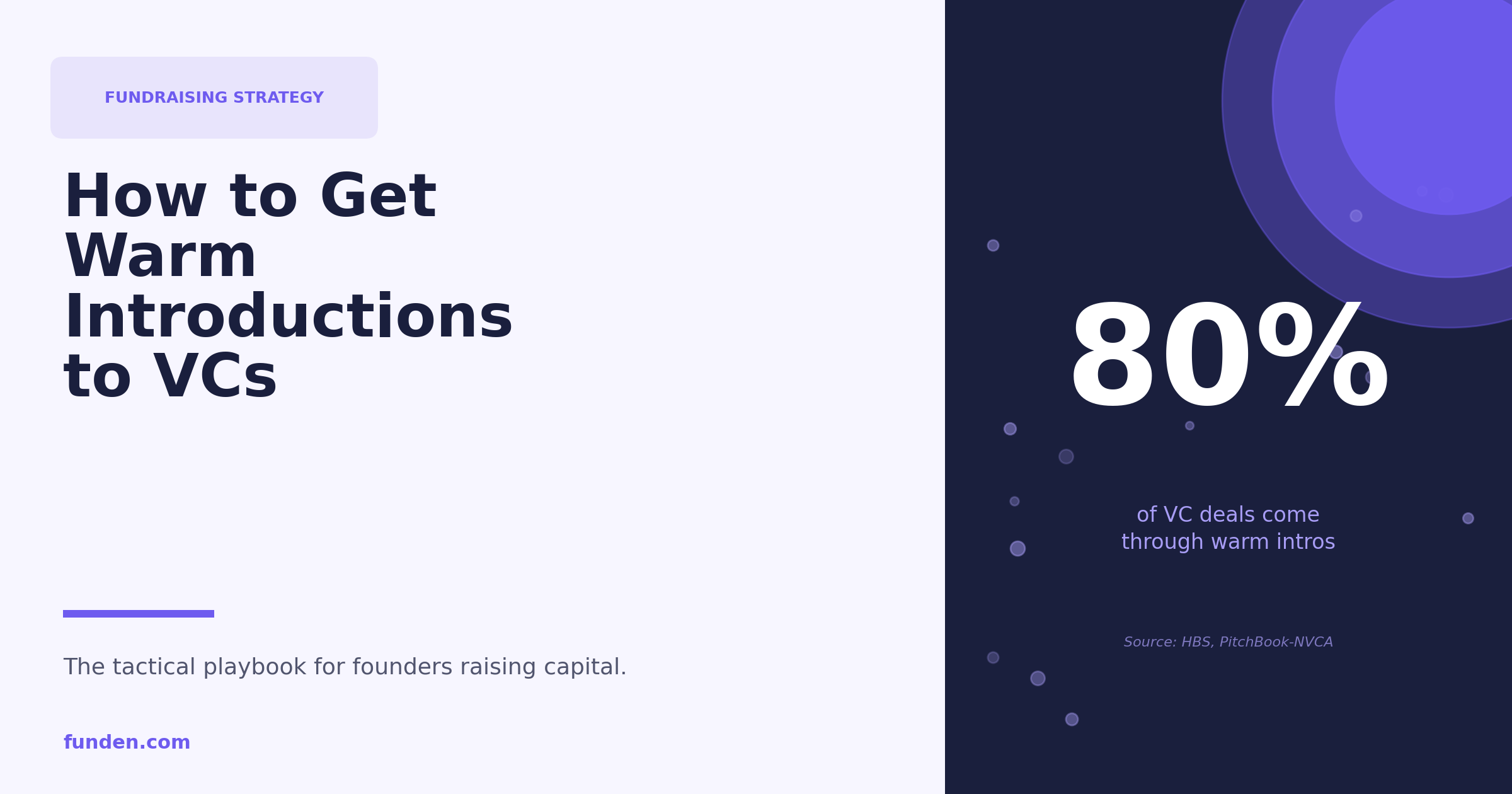
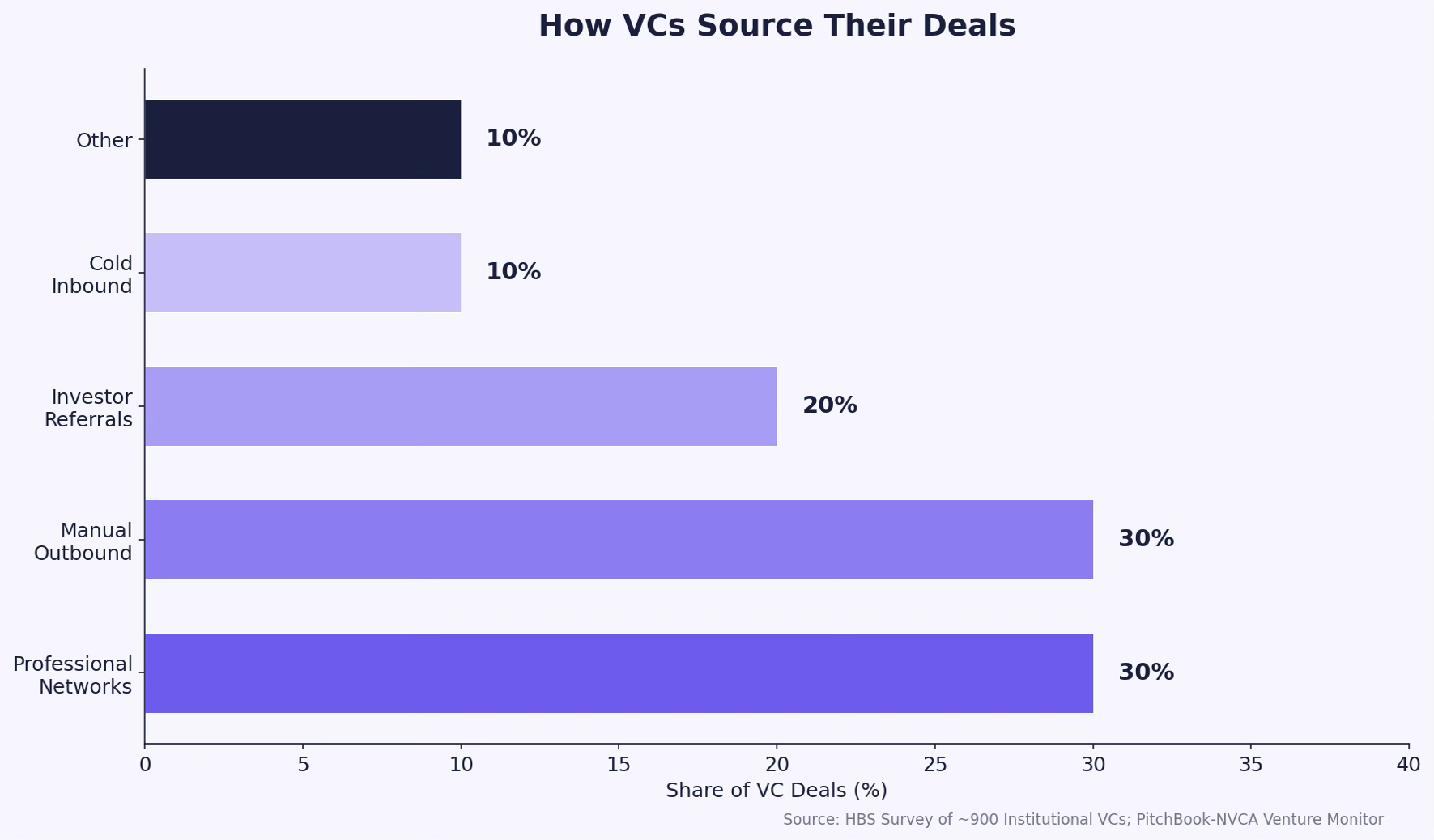
A Harvard Business School survey of nearly 900 institutional VCs found that roughly 58% of funded deals originate through professional networks, investor referrals, or portfolio company introductions. Add manual outbound sourced through relationships and the figure climbs to around 80%. Cold inbound, the channel most first-time founders default to, accounts for approximately 10%.
Those numbers are not new, but the gap is widening. As capital concentrates into fewer deals and fewer firms, per the PitchBook-NVCA Venture Monitor Q1 2026 data, investors have less time and more reasons to filter by trust signals before evaluating business quality. The warm introduction is the highest-signal filter available to them.
This guide is not about networking platitudes. It is a tactical breakdown of how founders can systematically build, request, and convert warm introductions into investor meetings, based on what we see working across hundreds of fundraising processes.
Why Warm Introductions Work (And Why Cold Email Doesn't)
VCs receive 300 to 500 inbound email pitches per month. They read maybe 50 fully. They schedule meetings for 3 to 5. If you arrive as an unvetted email, you are competing with 99 others that day. If you arrive as an introduction from a portfolio founder the investor already trusts, you are competing with the last two meetings before the investment committee.
The difference is not marginal. Warm introduction response rates consistently run 20 to 40%, compared to 1 to 3% for cold outreach. Meeting show rates from warm intros are 85 to 95%, versus 50 to 60% for cold-sourced meetings. The compounding effect through the rest of the funnel is significant: shorter discovery calls, faster diligence, and higher close rates.
This matters because the warmth does not make your company better. It makes the investor's decision-making easier. VCs are pattern-matching machines, and a referral from a trusted source is a shortcut through the noise.
Not All Warm Introductions Are Equal
Founders often treat all introductions as interchangeable. They are not. The conversion gap between different types of connectors is massive.
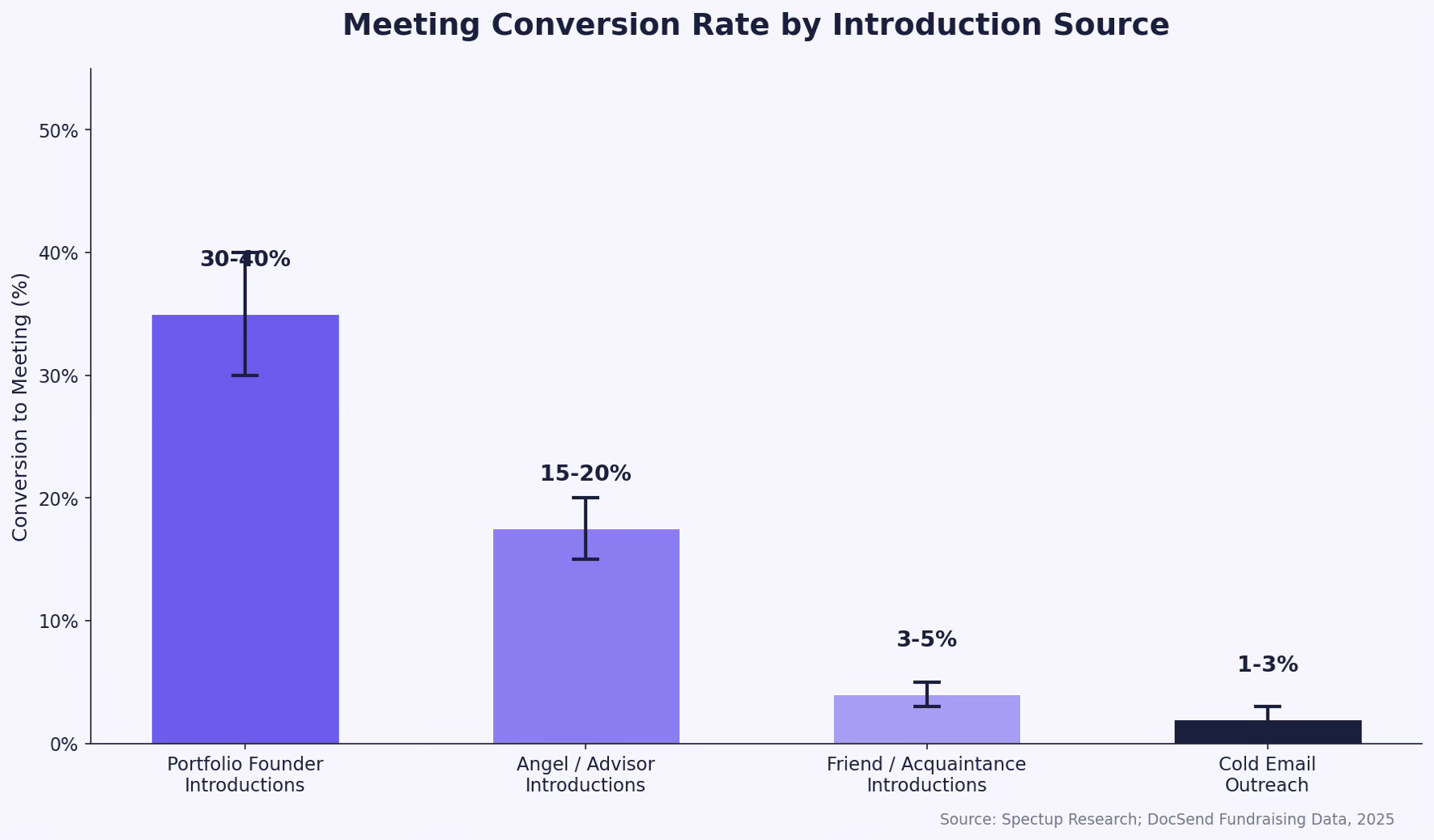
Portfolio founder introductions, where someone who has already been funded by the target VC makes the connection, convert to meetings at 30 to 40%. These carry the most weight because the connector has a direct, ongoing financial relationship with the investor. Their reputation is on the line.
Angel investors and advisors convert at 15 to 20%. They have credibility in the ecosystem, but their relationship with the specific VC may be more distant. Friends and acquaintances sit at 3 to 5%, barely above cold outreach. The lesson: the strength of your connector's relationship with the investor matters more than the strength of your relationship with the connector.
SaaStr founder Jason Lemkin has made a related point from the investor side: 90% of warm intros are a waste of time unless they are "double qualified," meaning the connector actually understands what makes a good venture investment and has vetted the fit between the founder and the specific investor's thesis. A well-meaning friend who has no context on the VC's portfolio strategy is not delivering a warm intro. They are delivering a slightly warmer cold email.
Map Your Introduction Paths Before You Need Them
The single biggest mistake founders make is treating introductions as a fundraising activity. They are a pre-fundraising activity. Start 10 to 12 weeks before you need capital, not when you are already running a process.
Begin by building your target investor list. Identify 30 to 50 investors who are a genuine thesis fit, not just any VC with a checkbook. For each investor, map the introduction path on LinkedIn: who in your network has a first-degree connection to them? Prioritize connectors in this order:
1. Portfolio founders of the target fund (highest conversion, highest signal).
2. Your own existing investors and advisors (they have financial incentive to help you raise).
3. Other founders who have recently fundraised and met with the target investor.
4. Industry professionals, lawyers, or accountants who work with that VC's portfolio companies.
If you cannot find a warm path to an investor, that is useful information. It either means the investor is outside your ecosystem (and probably not a fit), or you need to invest time building the relationship before making the ask. Attend the events they attend. Comment thoughtfully on their content. Build familiarity before you need anything.
Use Double Opt-In, Every Time
In 2009, Fred Wilson, co-founder of Union Square Ventures, proposed a simple practice he called the "double opt-in introduction". The concept: before connecting two people who do not know each other, the intermediary checks with both sides first. If either says no, the introduction does not happen.
This practice is now near-religious in Silicon Valley. Its rapid adoption reflects a deeper truth about venture capital: the two most prized resources in the industry are time and personal networks. A forced introduction wastes both.
For founders, this means never asking a connector to send a blind CC introduction. Instead, ask them: "Would you be comfortable checking with [Investor] whether they are open to an intro?" Send your connector everything they need to make the ask easy, which brings us to the most important asset in your fundraising toolkit.
Write a Forwardable Blurb That Does the Work
The forwardable blurb is the single most underused tool in fundraising. It is a short, self-contained description of your company that your connector can paste into an email and hit send. Eric Bahn, co-founder of Hustle Fund, uses forwardable blurbs nearly a dozen times a day. It is one reason Hustle Fund raised $46.1 million for their third fund.
A strong blurb is under 120 words. It covers four things: what you do (one sentence), your strongest traction proof point, why this specific investor is a fit, and a link to your deck. That is it. No vision statements. No market sizing. No three-paragraph founder backstory.
Here is the formula that works:
[Company name] is [one-line description]. We are at [traction metric, e.g., $200K ARR growing 15% MoM, 50 enterprise customers, 10x retention vs. industry average]. We are raising a [$X round] and [Investor Name] is a strong fit because [specific reason tied to their thesis or portfolio]. Deck attached.
The key principle, as multiple operator guides emphasize: make it effortless for the person doing you the favor. The more your connector has to think and write, the less likely the intro actually happens. Providing a forwardable blurb can double the chances of getting the introduction made.
Timing and Sequencing: How to Run the Intro Campaign
Timing matters more than most founders realize. Founders who begin building intro paths six or more months before their raise close at higher valuations, because they enter the process with momentum rather than desperation.
Do not ask one connector to make 10 introductions. Focus on their two or three strongest connections, the ones where they have real social capital. A request for one well-targeted intro signals respect for the connector's network. A request for a dozen signals that you have not done your homework.
After the intro is made, your follow-up cadence matters as much as the intro itself. Respond within 24 to 48 hours. If the investor does not respond within a week, send one gentle follow-up to your connector asking whether they have heard back. If nothing materializes after a second gentle nudge, move on without burning the relationship. Some people agree to introductions they are not actually comfortable making. Accept that and maintain enough parallel paths that one stalled intro does not derail your timeline.
One caveat that seed-stage investors evaluate differently than Series A leads: at seed, a strong narrative and founder credibility can carry the meeting. At Series A and beyond, VCs will expect the intro to come paired with hard metrics. Adjust your blurb accordingly.
What If You Do Not Have a Network Yet?
This is the hardest question in fundraising, and the most common one from first-time founders. The honest answer: it takes time, but there are accelerated paths.
Accelerator programs remain the fastest network hack. Y Combinator alumni raise follow-on funding at significantly higher rates and valuations than comparable non-YC startups, largely because the alumni network provides warm introductions that would take years to build organically. Programs like Techstars, 500 Global, and On Deck have similar (if smaller) effects.
Outside of accelerators, the playbook is straightforward but requires consistency. Meet other founders who are six to twelve months ahead of you in their fundraising journey. Attend investor-facing events, not to pitch, but to build genuine relationships. Publish your thinking on LinkedIn or in founder communities. Ask for advice calls, not investment calls. Over time, the advisors and founders you build relationships with become the connectors who make introductions on your behalf.
There is a structural inequity here worth acknowledging. Founders from underrepresented backgrounds, those without elite university networks or existing connections to the VC ecosystem, face a steeper path to warm introductions. This is a real problem the industry has not solved. Research shows that 40% of all VCs went to just two schools, which creates significant network overlap and limits access for outsiders. Working with fundraising advisory firms, joining diverse founder communities, and targeting investors who explicitly source outside their networks can help mitigate this gap.
Five Mistakes That Kill Warm Introductions
After working with over 1,300 founders through the capital readiness process, we see the same patterns repeatedly:
1. Asking for the intro before the relationship is warm enough. If you met someone at a conference once and never followed up, you do not have a warm connection. You have a LinkedIn contact.
2. Sending the blurb through the wrong channel. Sharing your forwardable blurb via WhatsApp or Telegram instead of email makes it harder for the connector to forward it professionally.
3. Writing a blurb that is too long. If your company description exceeds 250 words, no one will forward it. Keep it under 120.
4. Not responding quickly once the intro is made. Investors form impressions fast. DocSend data shows investors spend 2 to 3 minutes on a first-pass deck review. If you take a week to reply to an introduction, you have already lost.
5. Failing to thank the connector. Whether the intro converts or not, close the loop. A connector who feels appreciated will make introductions again. One who feels used will not.
The Introduction Is the Beginning, Not the End
A warm introduction gets you in the room. It does not close the deal. Once you are there, the quality of your deal, your narrative, your metrics, and your ability to withstand diligence scrutiny is what determines the outcome.
What we see across hundreds of fundraising processes at Funden is that the founders who raise successfully are not the ones with the most introductions. They are the ones who go to market with an institutionalized deal, a stress-tested narrative, and a clear understanding of how investors will evaluate them. The introduction is a door. What you bring through it is what matters.
If you are preparing for a raise and want structured feedback on your deal before going to market, Funden works with founders to pressure-test their narrative, benchmark their round, and make targeted introductions to our network of 1,000+ partner funds. Apply at funden.com.